
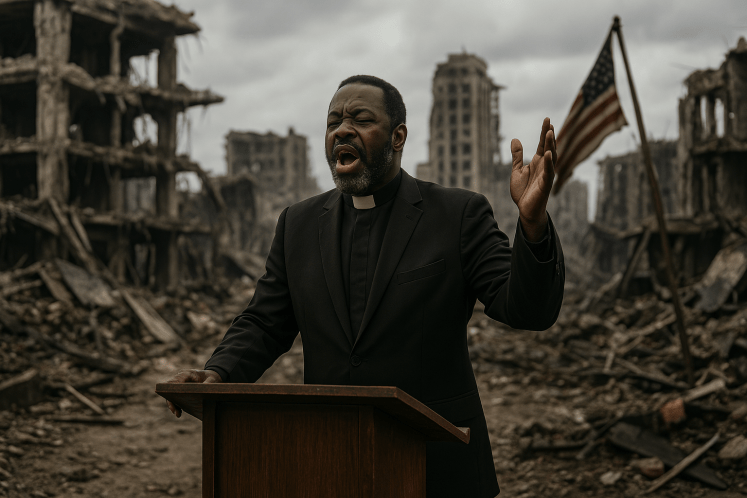
“The bottom line is that the unaddressed effects of racism limit the believer’s spiritual development. This stunted development leads to institutional collapse and divine judgment.”
The biblical role of the pastor is the feeding and protection of the flock of God, the local church.[1] To do this job properly, the pastor must be a mature believer, a master of the Word of God, and able to make disciples.[2]
However, it must not be overlooked that the pastor of the local church must also be in touch with reality.[3] This requirement is essential for the black pastor, since reality orientation, or its absence, has been a matter of life and death for both him and his black congregation throughout American history. This history has been characterized by both illegal and state-sanctioned violence towards blacks irrespective of their spiritual status. America hasn’t, nor does it today, spare blacks from the injustices built into its systems of law and commerce because of their religion or theology. Nor have black believers ever been exempted from the periodic [and currently overdue] white terror campaigns against black prosperity. Consequently, the black pastor as the spiritual authority of the local church should be, through the Word of God, its anchor to reality.
There is a psychological tax levied against every member the black community because of intergenerational and systematic racism[4] that can only be effectively treated by spiritual action.[5] In addition to the many physical effects of racial injustice, this psychic burden can warp personality, impacting marriages, families and communities. Only the men called by God to lead the local churches are spiritually equipped to rescue people from the spiritual assault of racism and to provide the spiritual basis for the rebuilding of the black soul, community and nation.
Today, right now, there is a convergence of a white supremacy movement and complicit white evangelical pastors and congregations which have the power of government firmly under its control. A large percentage of the general population support this movement and are willing to sacrifice their present wellbeing and the futures of their children to see a white supremacy agenda legally implemented that will penetrate every institution, presumably forever.
The problem for black folks is that in black local churches, many pastors are living in a dream world where they are unable to perceive and unequipped to properly address the reality that the people in the pews are facing everyday. These pastors are detached from reality: because of incorrect theology, because they do not know what to do about the problem, because of straight-up fear, perhaps because of close association with white pastors who encourage their black counterparts to exclude race from their spiritual calculations.Subscribed
The bottom line is that the unaddressed effects of racism limit the believer’s spiritual development. This stunted development leads to institutional collapse and divine judgment.
The pastor who will not or cannot address the effects of racism upon his own church becomes the initiator of a negative spiritual chain reaction in which the local church gradually becomes the source of the spiritual problems in the community.[6]
There are, perhaps, four categories of black pastors who suffer from a deficient reality orientation when it comes to the racialized structure of American society and its effect upon their church members, families and community.
1. The “Scairt”
2. The Victim of Slave Theology
3. The Victim of Racial Reconciliation
4. The Liberal Freedom Fighter
1. The “Scairt”
This pastor realizes the problem and sees the suffering in his congregation due to racism. He is painfully aware of the sharp turn the government and the nation has taken and the central role that racism is playing in pacification of the white population while their own (white) rights are systematically eliminated. Despite this, there is an internal alarm within him that prevents him from addressing race and the Bible at the same time. Sometimes, he is afraid of being accused of playing the race card and profiting off “victim” status. At other times, he fears that a frank discussion of race would offend the one half of one percent of his church members that are white. He knows better, but he’s just scairt. He is out of touch with reality because what he fears is absolutely nothing compared to what is coming his way in the future. What he and his people need most is to be spiritually healed from past injury and spiritually equipped for what is unfolding before their eyes. He needs to remember the attitude of Isaiah, Jeremiah, Ezekiel and Amos in their preaching and their willingness to fearlessly address the spiritual, political and social realities of their times. He needs to realize that he will give an account for his stewardship over the local church.[7]
2. The Victim of Slave Theology
This man was taught somewhere that there is no such thing as race in theology.[8] He has been taught that the new birth eliminates race as a factor in life. Because of his instruction in a faulty Christianity, he has been rendered incapable of perceiving the integral role of the white fundamental and evangelical churches in the establishment and maintenance of systems of racial oppression up to this very day. Neither does he see that the version of Christianity that he has been taught provides different rights and prerogatives based upon race. For example, the fact that black Americans have distinct interests is a heresy to this man, even though this truth is allowed for every other ethnic group who are Christians. The white churches still today hold to a practical segregation that is not at odds with their notions of sin and righteousness. Specific actions are taken to limit black male leadership in white churches and to limit the presence of adolescent males. Self-defense is discouraged for blacks under slave theology, while it is a cherished right to white believers. The black pastor who is the victim of Slave Theology will fight with all his strength to deny the need to apply the Scriptures to his congregations’ problems resulting from racism, because he believes his is the doctrinally correct position and therefore the will of God.
3. The Victim of Racial Reconciliation
This black pastor has several cordial relationships with white pastors in his community. Their churches meet for fellowship and worship now and then. The white pastors are happy to acknowledge the issue of race within certain limits. They can work together upon the problems of black individuals such as addiction, single parent households or homelessness in the community. However, the systemic reasons for these problems are not discussed nor are attempts made to address the causes of black pathology. Both the black and white churches are segregated, not on purpose, but because of the carefully avoided presupposition that people are more comfortable in a homogeneous environment.
This pastor has been convinced that race is an individual problem and not related to systems and power relationships. He firmly believes that racial issues can be corrected by communication and fellowship with white believers and once reconciliation is achieved, the problem of race is largely resolved. To him, the key activity is continuing to establish relationships across racial lines. This pastor does not perceive the psychological, relational and spiritual damage being done to his congregation by intergenerational systems of racial oppression. He agrees with his white friends that the source of black pathology is unrelated to white actions because slavery is long past. He will often argue that rather than complaining, black people need to appreciate the greatness of America. He minimizes the significance of the political commitments of the white churches with whom he has reconciled. He firmly believes that the bible teaching that white people utilize in their churches is all that is needed in his own church. This black pastor, because of his loyalty to his white pastor friends and his limited success in fellowship with them, is entirely uncomfortable with the idea that race should be systematically addressed in Scripture and solutions specifically applied to his people. He will not jeopardize these interracial relationships over what he sees as merely a “political issue”, but he cannot see the significance of that fear.[9]
4. The Liberal Freedom Fighter
This preacher is an outspoken and eloquent voice for the black Christian and for black people in general. He is acutely aware of the national situation and its danger to the way of life of black Americans. Because of his oratorical skill he is well known with a large congregation and social media following. He is not to be trifled with, powerfully refuting both clergy and laymen who are willing to question the validity of his claims. He is loved by his congregation who feel protected and fed by their pastor.
The Liberal Freedom Fighter is disoriented to reality because he really doesn’t believe the Word of God. While he thoroughly rejects Slave Theology, he also doubts the inspiration of the Bible and has a faulty understanding of salvation. What he does understand is the tradition of the black churches. He knows how to pray, how to preach and how to sing, but his people are not being prepared spiritually for this life or the life to come. This is the most serious reality disorientation, misalignment with the solution God provided for mankind’s sin through Jesus Christ. Every problem in life finds its solution in Him, including the insidious damage caused by racial discrimination.
Conclusion
A word to black pastors. Black people have been speaking in code[10] when around white people since the days of slavery. This was necessary to communicate without incurring the certain retaliation that resistance to oppression would bring. That retaliation still occurs today, usually in non-violent ways. Often the only thing that prevents us from saying to our congregations the things that need to be said is an internal alarm that warns you to resort to coded language or avoid the topic altogether. Add to this the accusation by whites and some black people that by teaching your people directly about these things you are sowing division in the church and drawing focus away from Christ. These are effective internal and external safeguards that prevent important teaching that black believers must hear.
Others among you are convinced that there may be racism embedded in our society, but it is a spiritual problem for the whites who participate in the system, not us. You should see by now that this is false. The only audience that you have any reasonable chance to rescue from the spiritual effects of racism is your own congregation.
Still others do not want to be stigmatized, you see issues like these as many white pastors like to see them: as side issues, peripheral concerns that do not pertain to the gospel or the kingdom of God. Racism as a spiritual strategy of Satan and its role as an organizing principle of western society depends upon your retaining these positions.
On the other hand, the spiritual health of your congregation and the spiritual revival of your community depend upon the overthrow of these false concepts. No nation or people has ever overcome the nullification of their pulpits (First Principle of Nationbuilding). You must understand the issues and the stakes and then speak plainly to your Congregation, providing spiritual guidance resulting in restored mental health, a biblical self concept and a capacity for effective spiritual ministry to the Community.
[1] John 10.12; Acts 20.28
[2] Titus 1.7-9
[3] Romans 12.3. also Walker, Richard G.. Revival and Nationbuilding: A Biblical Guide to Black Nationbuilding (Chapter 7). A Richer Walk Ministries. Kindle Edition.
[4] “Racism is the science of discrimination. Racism is the calculated introduction of discrimination into the institutions of society. Racism is a conspiracy to scientifically marginalize or destroy a specific racial group by the manipulation of the organs of society such as the family, government (including legislation, law enforcement and the courts), academia, the media, and the church. Therefore racism, by this definition, although implemented by individuals, is always structural. Racism is cultural warfare, or the extension of conventional warfare to the cultural sphere.” Revival and Nationbuilding: (p. 30)
[5] Revival and Nationbuilding (Chapters 5, 6)
[6] Revival and Nationbuilding (Chapters 8-9)
[7] 1 Peter 5.1-4
[8] Romans 9.1-4
[9] If black believers are being victimized and spiritually weakened by racism, why would applying the Word of God to the problem jeopardize his relationships with the white churches? What then is the value of their “reconciliation?”
[10] “Broadly, code-switching involves adjusting one’s style of speech, appearance, behavior, and expression in ways that will optimize the comfort of others in exchange for fair treatment, quality service, and employment opportunities. Research suggests that code-switching often occurs in spaces where negative stereotypes of black people run counter to what are considered “appropriate” behaviors and norms for a specific environment.” McCluney, Courtney L., Kathrina Robotham, Serenity Lee, Richard Smith, and Myles Durkee. “The Costs of Code-Switching.” Harvard Business Review, November 15, 2019. https://hbr.org/2019/11/the-costs-of-codeswitching.
 A Richer Walk